Aether Gravity
A Minimalist Cosmic Space Simulator
// KEY CAPABILITIES // AETHER-GRAVITY
-
[01]
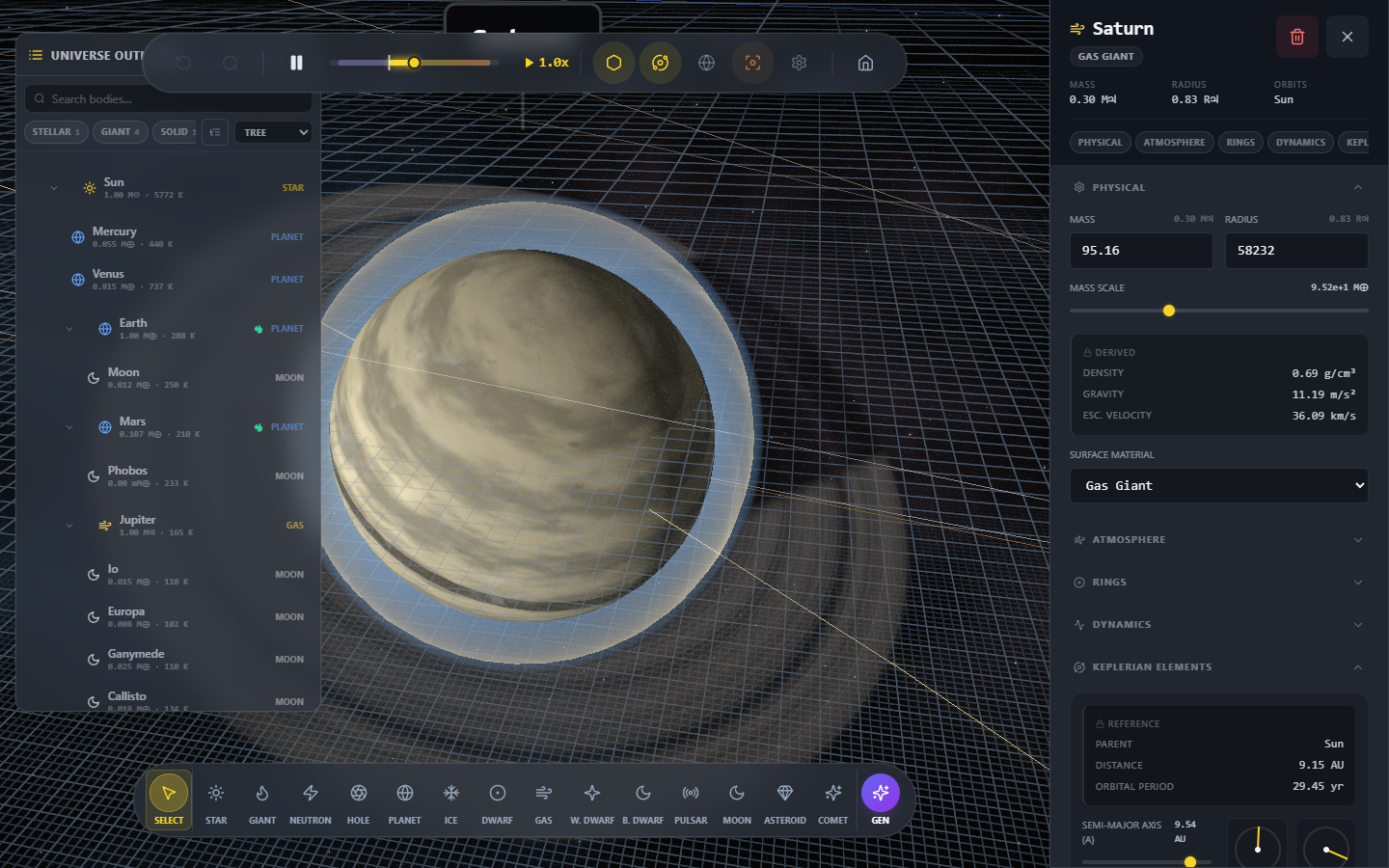
Real-time N-body physics with GPU-accelerated particle systems; Hill sphere and Roche limit stability tooling
-
[02]
Dynamic LOD black holes — Kerr-type horizons with gravitational lensing and relativistic Doppler effects
-
[03]
State-driven terrestrial shaders — procedural rocky and gas-giant surfaces with atmosphere and cloud layers
-
[04]
Universe sandbox — time control, precision launch mechanics, habitable-zone visualization, and supernova events
// PIPELINE SPECIFICATION
Features real-time gravitational interactions with GPU-accelerated particle systems,
Hill sphere and Roche limit stability tooling, Kerr-type black holes with gravitational
lensing and relativistic Doppler effects, procedural rocky and gas-giant planetary
surfaces with cloud and atmosphere layers, plus a full universe sandbox with time control,
precision launch mechanics, habitable-zone visualization, and supernova events.
// CLASSIFICATIONS
#Space-Simulation
#N-Body-Physics
#GLSL-Shaders
#Mobile-App
SYS_02 // SOFTWARE
Archived Portfolio
ScholiLink
Production-Grade Student Platform — Real Auth, Real Rules, Real AI
// KEY CAPABILITIES // SCHOLILINK
-
[01]
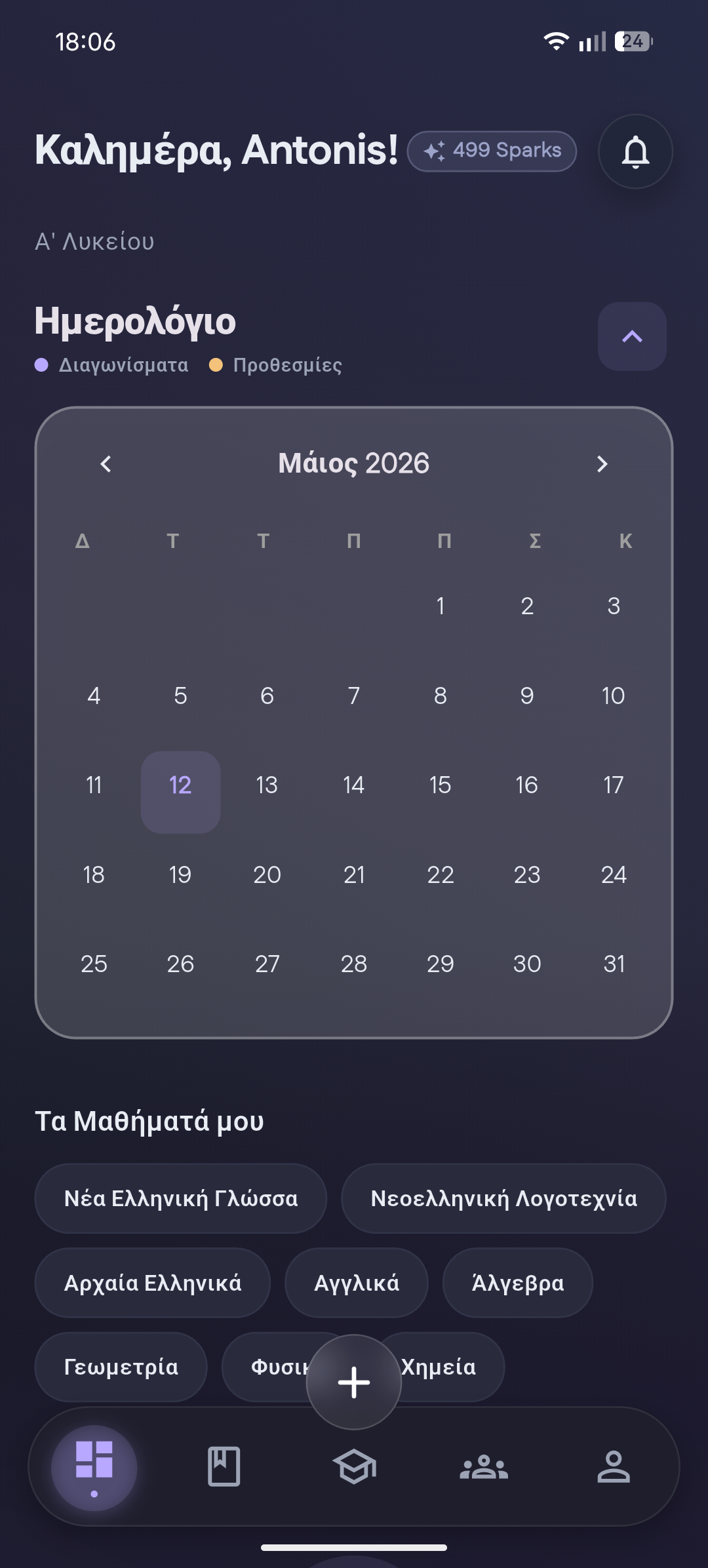
Dual-mode architecture — Firebase Emulator Suite + deterministic AI mocks vs. full live cloud + real Gemini, no fork required
-
[02]
Server-authoritative backend — quotas, safety scoring, social graph mutations, and AI orchestration in TypeScript Cloud Functions
-
[03]
Tight security rules — Firestore and Storage rules are uid-scoped and field-locked; server-only collections denied at the rules layer
-
[04]
AI done responsibly — Gemini called only through Functions, never from a client API key; OCR, tutoring, smart notes, exam quizzes
-
[05]
Student-grade UX — Sparks gamification, Greek-first localization, calendar + workload storytelling, polls + voice notes in chat
// PIPELINE SPECIFICATION
Ships with polished light and dark themes, Greek-first localization, and surfaces for
schedule, homework workflow, grades, AI study help via Gemini, classroom chat with voice
notes and polls, exam-readiness quizzes, and university Μορια planning — all secured
server-side. The AI is called exclusively through Cloud Functions; no API key is ever
exposed to the client.
// CLASSIFICATIONS
#Education-Tech
#Flutter
#Firebase-Architecture
#AI-Integration
Wind Turbine Project
Balcony Wind Turbine That Charges an 18650 Cell
// KEY CAPABILITIES // WIND-TURBINE
-
[01]
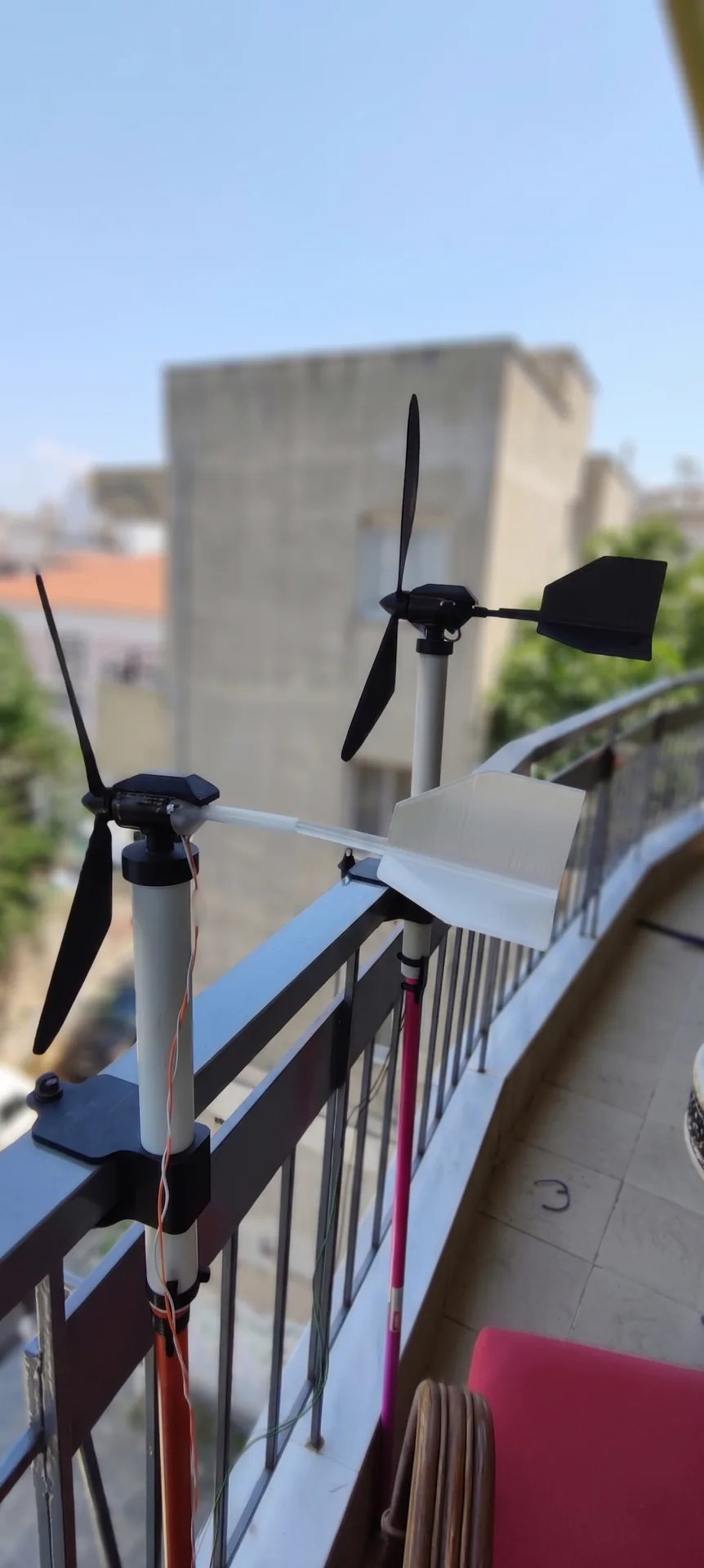
Motor-as-generator drivetrain — a three-blade printed rotor spins a small brushed DC motor, and a four-diode bridge rectifier keeps the output positive whichever way a gust turns it
-
[02]
Boost conversion — an MT3608 module lifts anything above about 2 V to a steady 5 V; each turbine has its own bridge and boost, and both outputs join at the charger
-
[03]
Protected 18650 charging — a TP4056 module with cell protection charges to 4.2 V, all hand-soldered on perfboard from three cheap modules with no custom PCB
-
[04]
Printed mechanics — tail boom and fin, yaw pivot, pole and a railing clamp with a locking pin, in Medium and Large print profiles (0.2 mm layers, 2 walls, 15% infill)
-
[05]
Interactive build guide — a live site with an animated energy-flow simulation, schematic, annotated board photo, soldering steps with checks, and an animated assembly
// PIPELINE SPECIFICATION
A 3D-printed balcony turbine that charges an 18650 Li-ion cell. The blades spin a small DC motor used as a generator; its voltage rises and falls with the wind, so it passes through a bridge rectifier, a smoothing capacitor, an MT3608 boost converter and a TP4056 charger before it reaches the battery. The charging box takes two turbines, and the whole chain is documented in an open-source build guide with the parts list, schematic and soldering order. It is a functional demonstrator of how real turbines work rather than a power source: at this scale the output is modest. Remix of Basic Wind Turbine by kjt270000 (CC BY).
// CLASSIFICATIONS
#Hardware
#3D-Printing
#Power-Electronics
#Open-Source
MoonCamp
Modular Moon Base — A Magnetic Two-Person Lunar Habitat
// KEY CAPABILITIES // MOONCAMP
-
[01]
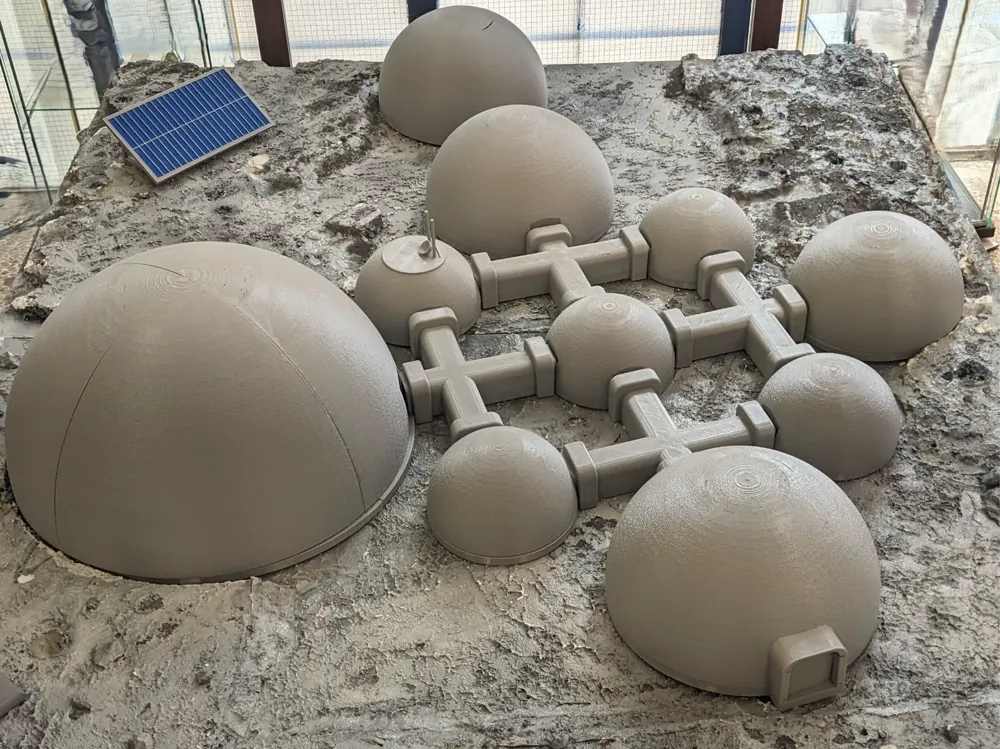
Fully 3D-printable, two-person lunar settlement built from specialized modules linked by enclosed corridors
-
[02]
Removable module domes and corridor covers held by 8 × 2 mm magnets reveal the detailed interiors
-
[03]
Cylindrical connectors join the sections, while movable corridor doors illustrate airlock isolation
-
[04]
Control, energy, ISRU, greenhouse, laboratory, living, medical, recreation, and rover spaces show the systems a long-duration habitat would need
-
[05]
English and Greek labeled versions support STEM displays and classroom exploration
// PIPELINE SPECIFICATION
Created for an ESA Moon Camp project, MoonCamp turns a lunar south-pole
settlement study into a modular physical display. Magnetic shells open to
reveal interiors and the connected layout makes power, resources, food,
research, healthcare, maintenance, and crew wellbeing easy to explore.
It is a conceptual educational scale model, not a certified habitat.
// CLASSIFICATIONS
#3D-Printing
#Modular-Design
#Magnetic-Assembly
#STEM-Display
LensTile
Open-Source Magnetic Image Tiles for Modular Glasses Cases
// KEY CAPABILITIES // LENSTILE
-
[01]
Local-first image pipeline — PNG / JPEG / WebP import with crop, pan, zoom, rotate, and flip; all processing stays on-device
-
[02]
Deterministic 1–8 color reduction with nozzle-aware preparation for 0.2 mm and 0.4 mm profiles and printability analysis
-
[03]
Smooth and Relief tile surfaces exporting one-filament STL and multicolor 3MF at the 148 × 53 × 4 mm Tile V1 spec
-
[04]
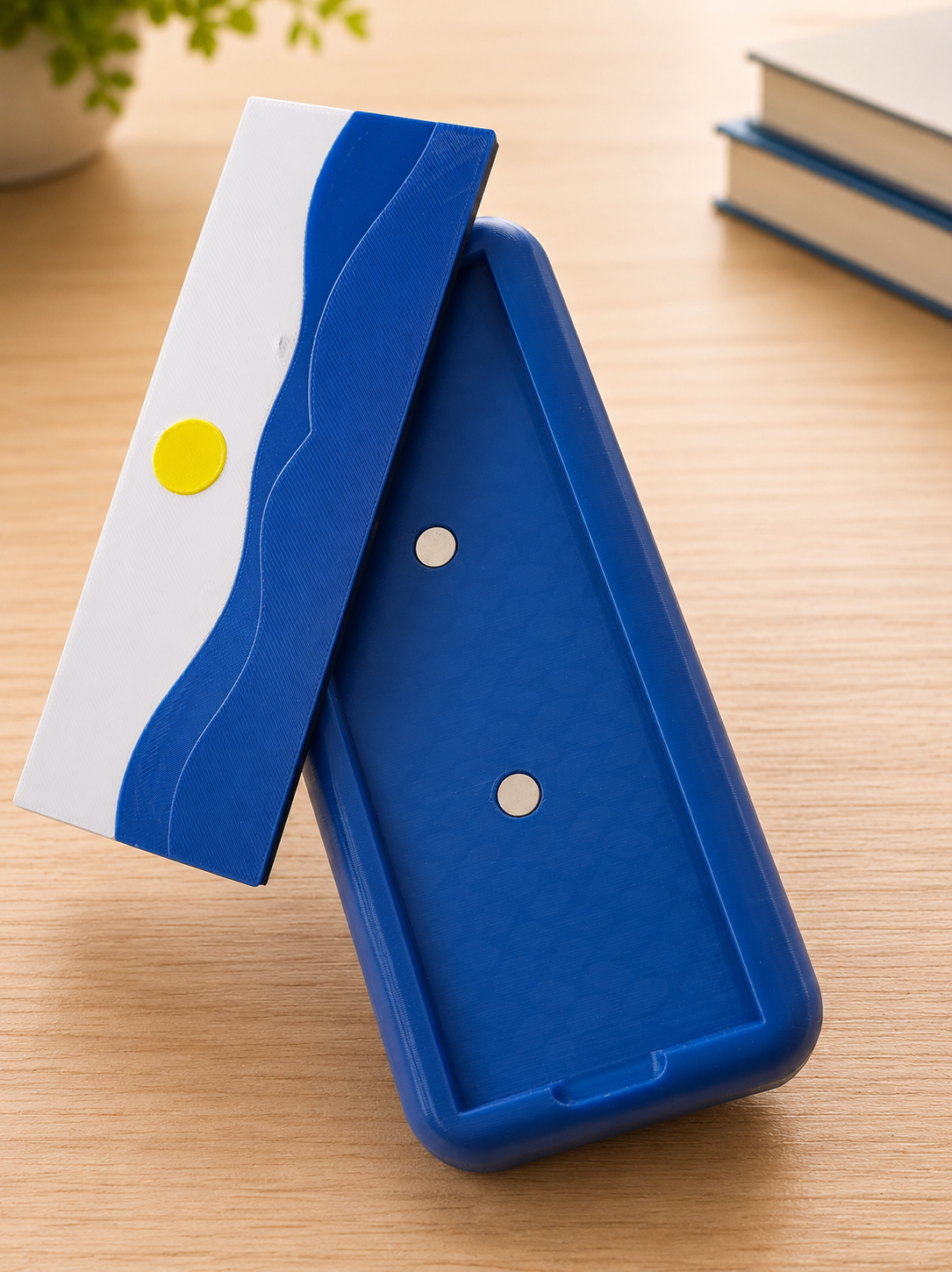
Modular magnetic hardware — custom glasses case with flush magnet recesses for swappable, printable image tiles
-
[05]
Zero runtime dependencies — no accounts, uploads, or analytics; privacy-first browser geometry and packaging via Web Workers
// PIPELINE SPECIFICATION
An integrated hardware–software system that turns a personal photo into a
printable magnetic tile for a custom modular glasses case. The browser app
fits artwork to a 148 × 53 mm frame, reduces it to print colors, checks
nozzle-aware printability, then builds Smooth or Relief geometry as a
one-filament STL or multicolor 3MF — with magnet recesses matching the
open-source case on MakerWorld. Everything runs locally; images never leave
the device.
// CLASSIFICATIONS
#Local-First
#3D-Printing
#Modular-Hardware
#Open-Source
BrickCast
Local-First STL / OBJ to Interlocking Brick Builds
// KEY CAPABILITIES // BRICKCAST
-
[01]
Local-first mesh pipeline — import STL / OBJ up to 75 MB, then ground, place, rotate, auto-orient, or pick a face as the build base
-
[02]
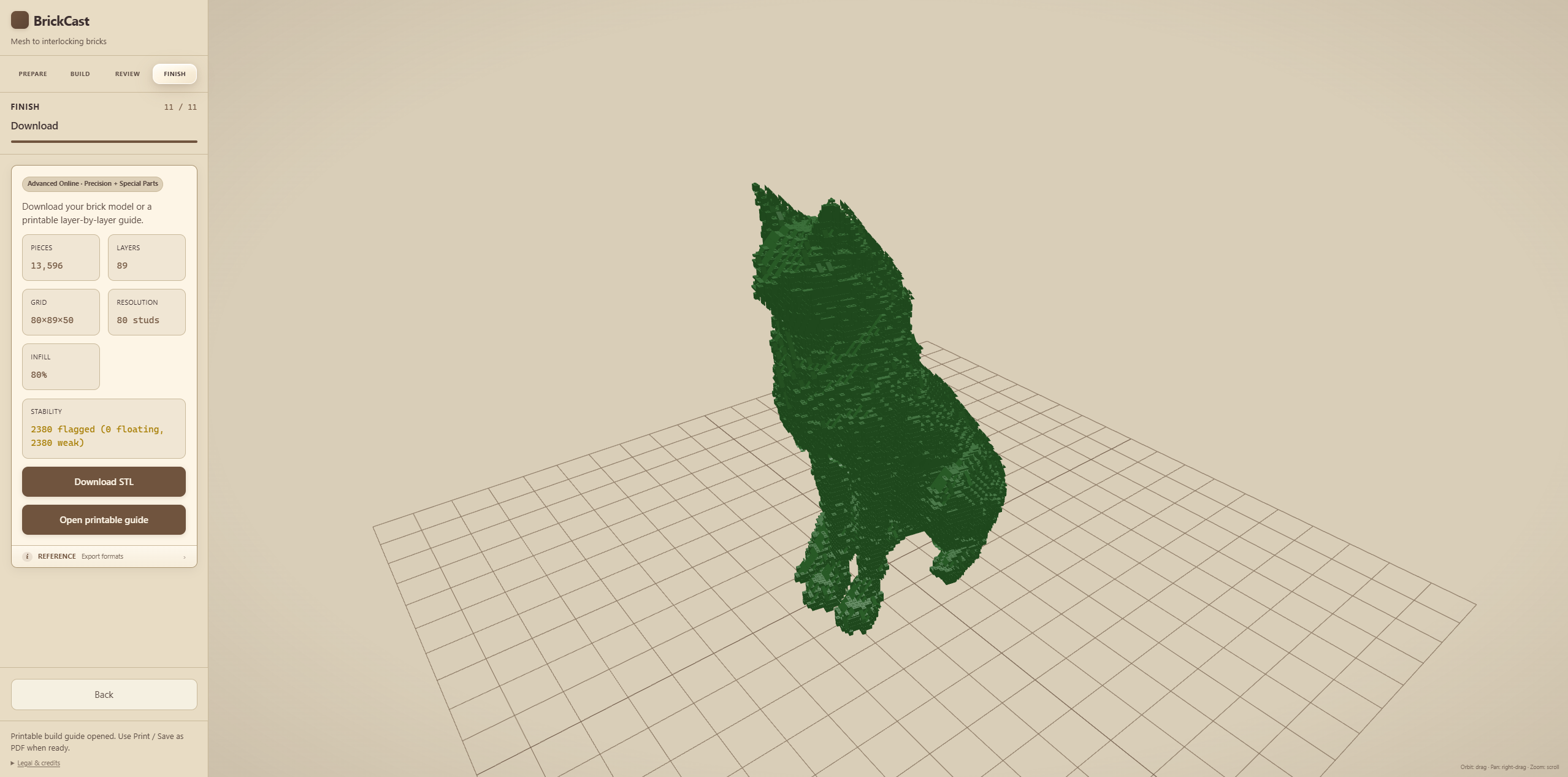
Configurable voxelization and brick packing — resolution, infill, and color controls that trade detail against piece count
-
[03]
Dual build modes — deterministic rectangular-only Offline builds, plus Advanced mode with slopes, plates, tiles, arches, and panels
-
[04]
Layer inspection and stability review — scrub Mesh / Grid / Bricks views and surface weak or floating connections before export
-
[05]
Parts inventory, printable build guides, and ASCII STL export — full guidance from converted geometry to physical assembly
// PIPELINE SPECIFICATION
A local-first browser system that turns triangle meshes into approximate
interlocking-brick builds. Most work stays on-device: orientation,
voxelization, packing, layer scrubbing, stability checks, inventory, and
printable instructions. An optional Advanced Online path can enrich special
parts through a local Python proxy without uploading the original STL/OBJ.
The result is an optimized brick design with full build guidance — from mesh
import to printable step-by-step layers.
// CLASSIFICATIONS
#Local-First
#Mesh-Conversion
#Brick-Builds
#Open-Source
Guardian System
Home Assistant RFID Entry, Presence & Camera-Driven Security
// KEY CAPABILITIES // GUARDIAN-SYSTEM
-
[01]
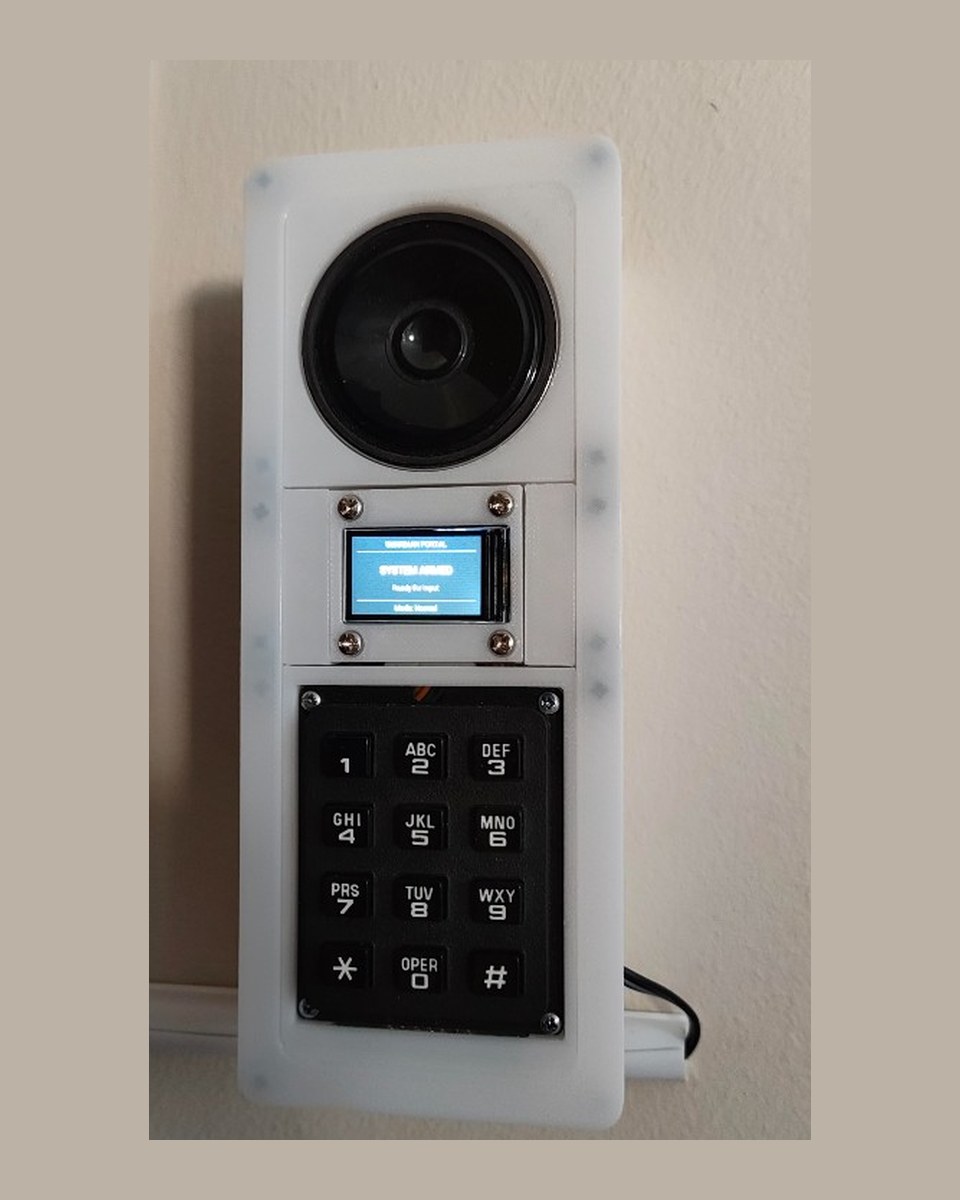
Two ESP32 RFID readers share one Home Assistant decision path for the interior portal and outdoor doorbell
-
[02]
Per-key presence tracking uses passage windows, door movement, reader intent, and a lever sensor to infer direction
-
[03]
Elevated mode can challenge an unauthenticated opening with a card and master PIN before sounding an alarm
-
[04]
Frigate person detection and measured camera brightness support alerts and automatic door-lamp control
-
[05]
Per-person phone alerts, stolen-card handling, device watchdogs, and a custom Home Assistant panel connect the system
// PIPELINE SPECIFICATION
Guardian combines Home Assistant automations with ESPHome firmware, two
printed RFID devices, a camera and door lamp, and a custom control panel.
It runs in one household as a documented DIY system, not a supported
security product. The offline siren and recent alarm-path changes still
need on-hardware verification.
// CLASSIFICATIONS
#Home-Assistant
#ESP32
#RFID
#Open-Source